
MBBR vs SBR vs MBR: Which STP Technology to Choose
Three popular biological treatment options compared side by side, so you can pick the right one for your site.
Quick Answer
The three most popular STP technology options are MBBR, SBR and MBR. MBBR uses floating plastic media to grow bacteria, giving a compact, robust plant that is easy to run. SBR treats and settles sewage in the same tank in timed cycles, with good nutrient removal. MBR uses membranes instead of a clarifier, giving the best treated water in the smallest space, at the highest cost.
On This Page
- The Common Ground: Biological Treatment
- MBBR: Moving Bed Biofilm Reactor
- SBR: Sequencing Batch Reactor
- MBR: Membrane Bioreactor
- MBBR vs SBR vs MBR: Side-by-Side Comparison
- How to Choose the Right STP Technology
- What About Conventional ASP and Extended Aeration?
- Pumping Needs by STP Technology
- Which STP Technology Fits Your Project? Five Scenarios
- Life-Cycle Cost of Each STP Technology
- Common Operating Problems by Technology
- Upgrading Old Plants with Modern STP Technology
- Questions to Ask STP Technology Suppliers
- Frequently Asked Questions
Choosing the right STP technology is one of the most important decisions in any sewage treatment project. It decides how much land you need, what your electricity bill will look like, how good your treated water will be, and how skilled your operators must be. In India, the three names you will hear most often are MBBR, SBR and MBR.
Each works well in the right situation and poorly in the wrong one. This comparison explains how each STP technology works, where it shines and where it struggles.
The Common Ground: Biological Treatment
All three are variations of biological treatment. Bacteria consume the dissolved organic matter in sewage while air is supplied by blowers. Where they differ is in how the bacteria are held in the tank and how the treated water is separated from the biomass. That separation step is often what decides plant reliability. For the full treatment chain, see our guide on how an STP plant works.
MBBR: Moving Bed Biofilm Reactor
In an MBBR, the aeration tank is partly filled with small plastic carriers, often 30–60% of the tank volume. Bacteria grow as a biofilm on the protected surfaces of the media. Air from the diffusers keeps the media moving, so it contacts the sewage continuously. After the reactor, a tube settler or clarifier separates the shed biomass. The process is well documented in the literature on the moving bed biofilm reactor.
Advantages
- Compact footprint
- Handles load and flow swings well
- No sludge recirculation needed for the biofilm
- Simple to operate
- Easy to upgrade by adding media
Limitations
- Needs good screening to keep media in place
- Treated water quality depends on the settler
- Media retention screens need cleaning
- Less effective nutrient removal without extra stages
Best for: apartments, hotels, hospitals, offices and small townships where space is limited and operators have moderate skills. It is the most common technology in an STP plant for apartments.
SBR: Sequencing Batch Reactor
An SBR does everything in one tank, in timed cycles: fill, react (aerate), settle, decant and idle. Because settling happens in still conditions, separate clarifiers are not needed. By adjusting aeration and anoxic periods, an SBR can achieve good nitrogen and phosphorus removal. See the overview of the sequencing batch reactor.
Advantages
- No separate clarifier
- Good nutrient removal
- Flexible cycle times for variable loads
- Good treated water quality
Limitations
- Depends heavily on PLC automation and valves
- Needs at least two tanks or storage for continuous inflow
- Decanters and level controls need upkeep
- Higher skill for troubleshooting
Best for: municipal plants, townships and projects with nutrient removal requirements and reliable automation support.
MBR: Membrane Bioreactor
An MBR combines an activated sludge tank with submerged or external membranes, usually microfiltration or ultrafiltration. The membranes physically block suspended solids and most bacteria, so the clarifier is not needed and the plant can run at high biomass concentration. The result is a very compact plant with near reuse-quality water. Learn more about the membrane bioreactor.
Advantages
- Best treated water quality, very low TSS
- Smallest footprint
- Ideal feed for RO or high-grade reuse
- Not dependent on sludge settling
Limitations
- Highest capital cost
- Membrane fouling and chemical cleaning
- Membrane replacement every few years
- Higher energy for air scouring
- Very fine screening needed
Best for: premium commercial buildings, IT parks, hospitals, basements with tight space and projects targeting high-grade reuse or Zero Liquid Discharge.
MBBR is the practical all-rounder, SBR the flexible performer, and MBR the premium choice when water quality and space matter most.
MBBR vs SBR vs MBR: Side-by-Side Comparison
| Factor | MBBR | SBR | MBR |
|---|---|---|---|
| Footprint | Compact | Compact to moderate | Smallest |
| Treated water quality | Good | Good to very good | Excellent |
| Nutrient removal | Limited without extra stages | Good | Good with design |
| Capital cost | Moderate | Moderate | High |
| Power use | Moderate | Moderate | Higher |
| Operator skill | Low to moderate | Moderate to high | High |
| Shock load tolerance | High | Moderate | Moderate |
| Key wear items | Media screens, diffusers | Decanter, valves, PLC | Membranes |
How to Choose the Right STP Technology
Ask these questions before you decide:
- How much land or basement space is available?
- What treated water quality do your consent and reuse plans require?
- Are nitrogen or phosphorus limits part of your norms?
- How variable is the sewage flow through the day and the year?
- What is your budget for capital cost versus running cost?
- Who will run the plant, and how skilled are they?
- Are spares and service available locally?
Cost has a big influence on this decision. Our sewage treatment plant cost guide explains how technology choice affects both purchase price and running cost. Outlet requirements are covered in our article on CPCB STP norms.
What About Conventional ASP and Extended Aeration?
The conventional activated sludge process and extended aeration are still widely used, especially in municipal plants and projects with open land. They need larger tanks and clarifiers, but they are well understood and forgiving. Many older plants are being upgraded by adding MBBR media to existing aeration tanks, which increases capacity without new civil work.
Pumping Needs by STP Technology
Whichever STP technology you choose, the plant still needs reliable pumps. The differences are in the details:
- MBBR: sludge from the tube settler must be removed regularly to holding and dewatering.
- SBR: waste sludge is drawn off at the end of cycles, often at higher concentration.
- MBR: high MLSS means thicker waste sludge, and chemical cleaning needs accurate dosing.
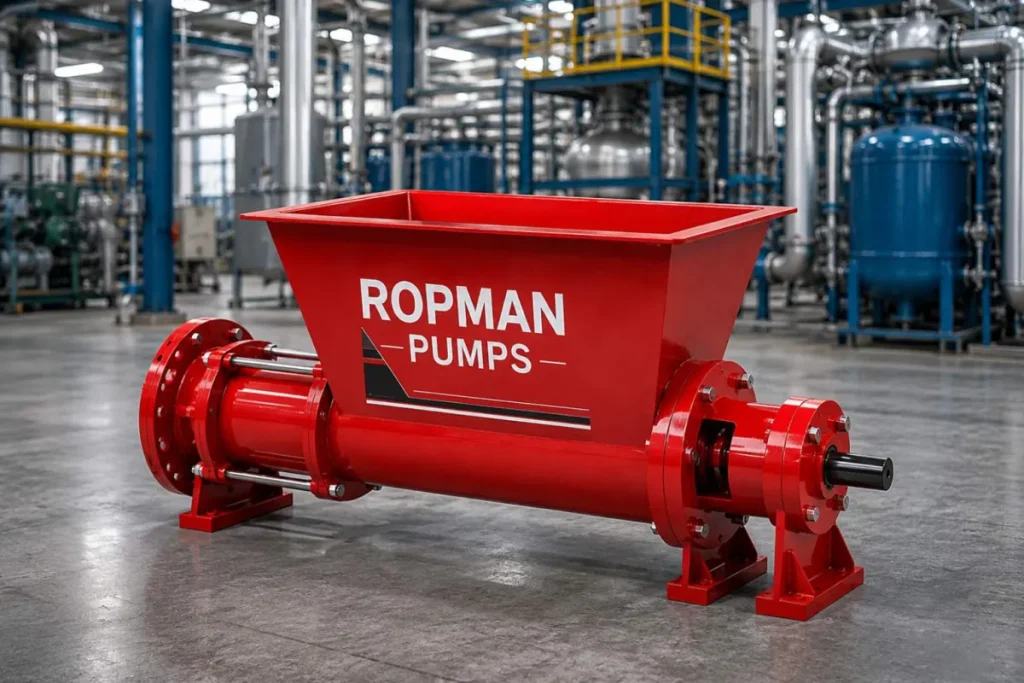
For thick sludge and filter press feed, a progressive cavity pump moves the media steadily without clogging. For chlorine, polymer and membrane cleaning chemicals, accurate dosing pumps are essential. Ropman Engineering Corporation manufactures both in Meerut, India. See our STP pump system guide for every duty.
Which STP Technology Fits Your Project? Five Scenarios
Comparisons are useful, but decisions are made on real sites. These typical scenarios show how engineers usually choose an STP technology.
Scenario 1: 80-Flat Apartment with a Basement Plant Room
Space is tight, operators are moderately skilled and the treated water will be used for flushing. MBBR with a tube settler, pressure sand filter, activated carbon filter and chlorination is the usual choice. It is compact, forgiving and easy to run.
Scenario 2: Luxury Hotel in a City Centre
The plant must fit a small basement, produce excellent water for cooling towers and landscaping, and never smell. MBR is often justified here, because the space saving and water quality outweigh the higher cost.
Scenario 3: Township with Phased Occupancy
Flows will grow over five to ten years and nutrient limits may apply. SBR in multiple basins or MBBR in parallel streams lets the plant start small and expand. SBR is attractive where nitrogen and phosphorus removal is required.
Scenario 4: Factory Canteen and Washrooms
Flow is modest and predictable, staff are available, and land is not an issue. Extended aeration or MBBR in a packaged unit is simple and economical.
Scenario 5: Municipal Plant Discharging to a River
Large capacity, strict nutrient limits and skilled operators are the norm. Conventional activated sludge with nutrient removal, or SBR, is commonly used, with MBBR increasingly used to upgrade existing tanks.
Life-Cycle Cost of Each STP Technology
Capital cost is only one part of the picture. Over 15 years, power, consumables and replacement parts often matter more than the purchase price.
| Cost Element | MBBR | SBR | MBR |
|---|---|---|---|
| Capital cost | Moderate | Moderate | High |
| Power | Moderate | Moderate, varies with cycles | Higher (aeration plus membrane scouring) |
| Major replacements | Diffusers; media lasts many years | Decanter parts, valves, sensors | Membrane modules every few years |
| Chemicals | Chlorine, polymer | Chlorine, polymer | Chlorine, polymer, membrane cleaning chemicals |
| Staff skill | Basic to moderate | Moderate to high | High |
| Tertiary treatment needed for reuse | Usually yes | Usually yes | Often minimal |
Because MBR often needs less tertiary treatment, its total cost gap with MBBR narrows when very high-quality reuse is required. For budgets by capacity, see our sewage treatment plant cost guide.
Common Operating Problems by Technology
MBBR
- Media piling up near screens
- Retention screens clogging with rags
- Poor settling in undersized tube settlers
- Dead zones if aeration is uneven
SBR
- Decanter or valve failures
- PLC timer or sensor faults
- Solids carry-over if settling time is cut
- Hydraulic overload at peak flows
MBR
- Membrane fouling and rising pressure
- Damage from poor screening
- Foaming at high MLSS
- Missed chemical cleaning schedules
Most of these are preventable with good screening, correct design margins and routine checks. Our STP maintenance checklist covers the daily and weekly tasks.
Upgrading Old Plants with Modern STP Technology
Many older activated sludge or extended aeration plants were built for smaller populations or looser norms. Rather than demolishing them, owners can often:
- Add MBBR media to the existing aeration tank to increase capacity in the same footprint (often called IFAS or hybrid MBBR).
- Convert tanks to SBR operation with new decanters and controls.
- Add membrane modules to produce reuse-quality water.
- Replace coarse aeration with fine bubble diffusers and efficient blowers.
- Add tertiary filters and UV for reuse.
- Replace clog-prone sludge pumps with progressive cavity pumps.
Upgrades need careful process checks, but they can raise capacity and treated water quality at a fraction of the cost of a new plant.
Questions to Ask STP Technology Suppliers
Before you choose a supplier:
- How many plants using this STP technology have you commissioned at a similar size?
- Can we visit or speak to the operators of a running plant?
- What treated water quality is guaranteed, and how is it tested?
- What media, membranes or decanters do you use, and what is their expected life?
- What are the connected and running power loads?
- Which parts wear out, and what do replacements cost?
- What training and after-sales support do you provide?
The best STP technology is the one your team can run well every day, not the one with the most impressive brochure.
Frequently Asked Questions
Which is better, MBBR or SBR?
Is MBR better than MBBR?
Which STP technology is best for apartments?
What is the full form of MBBR, SBR and MBR?
Which STP technology uses the least space?
Can an old STP be upgraded to MBBR?
How long do MBR membranes last?
Which STP technology has the lowest running cost?
Whatever the Technology, Sludge Must Move
Ropman progressive cavity and dosing pumps work in MBBR, SBR, MBR and conventional STPs. Tell us your sludge duty and we will size the right pump.
Request a Quote